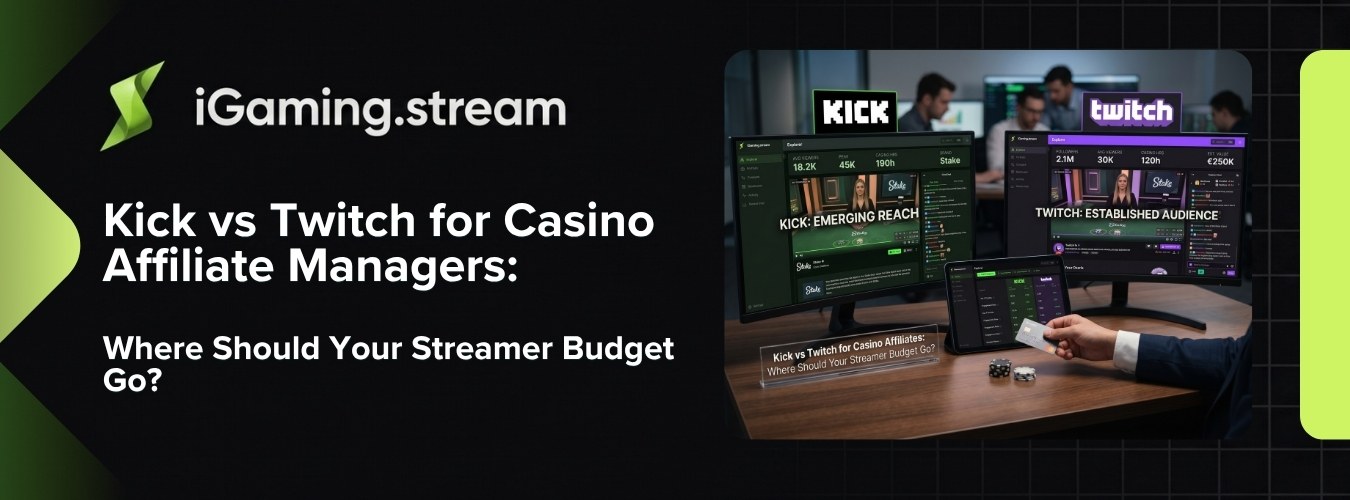
Kick vs Twitch for Casino Affiliates: Where Should Your Streamer Budget Go?
The gambling streaming landscape split in two. Kick became the home of high-stakes casino content. Twitch kept its regulated, brand-safe position. For affiliate managers allocating streamer budgets in 2026, this isn't a preference question — it's a data question. This analysis breaks down what the numbers actually show, and what they mean for your next partnership decision.
1. The Great Migration
When Twitch restricted gambling content in late 2022, the casino streaming ecosystem didn't shrink — it moved. Kick launched with an explicit welcome mat for gambling creators, offering better revenue splits and zero content restrictions on licensed casino play. Within months, the majority of high-profile gambling streamers had either migrated entirely or shifted their primary streaming hours to Kick.
By 2026, the split is structural, not temporary. Kick dominates casino-specific streaming in terms of raw hours and viewer volume. Twitch retains a presence in gambling through sports betting integrations and creators who mix gambling with other content categories. For affiliate managers, this means two fundamentally different ecosystems with different audience profiles, different compliance landscapes, and different partnership economics.
The question is no longer "Kick or Twitch?" — it's "what percentage of my budget goes where, and why?"
Key Insight
2. Kick vs Twitch by the Numbers
The raw numbers tell a clear story about where gambling viewership lives today. While we share aggregate market patterns here, the streamer-level intelligence that drives actual partnership decisions lives inside our platform.
| Metric | Kick | Twitch |
|---|---|---|
| Gambling category share | Dominant | Niche |
| Dedicated gambling streamers | Higher concentration | Mixed content creators |
| Avg. gambling session length | Longer (marathon format) | Shorter (mixed schedules) |
| Audience age skew | 18-30 heavy | Broader 18-40 |
| Geographic concentration | LATAM, MENA, CIS rising | NA, EU, Nordics |
| Regulatory restrictions | Minimal platform-level | Category restrictions active |
These are directional patterns, not the full picture. The actual viewer counts, hours streamed per region, and engagement rates per platform vary significantly by streamer tier and time zone — which is exactly what our platform tracks in real time.
How iGaming.stream Helps
3. Who's Watching — and Where
Platform choice matters less than audience composition. A streamer with 5,000 viewers on Kick and a streamer with 5,000 viewers on Twitch are not equivalent partners — because the people behind those numbers are different.
Kick gambling audiences skew younger, more mobile-first, and increasingly non-English. The fastest growth in Kick gambling viewership is coming from Portuguese-speaking, Turkish, Arabic, and Russian-speaking audiences. For operators licensed in markets like Curacao, Malta, or emerging LATAM jurisdictions, this is a significant opportunity. For operators focused on strictly regulated markets (UK, Sweden, Germany), this audience composition creates compliance considerations.
Twitch gambling audiences are more geographically concentrated in regulated Western markets. English-speaking, Nordic, and DACH audiences make up a larger share of Twitch's gambling viewership. For operators with UK, Swedish, or German licenses, Twitch streamers may offer better geographic alignment — even if the total viewership numbers are smaller.
How iGaming.stream Helps
The geographic and demographic data matters because it directly affects your cost per first-time depositor. A streamer with massive viewership in a market where you don't hold a license generates zero revenue — regardless of how impressive the viewer count looks.
4. Which Platform Delivers Better ROI?
This is the question every affiliate manager actually cares about, and the honest answer is: it depends entirely on your market, your product, and which streamers you're evaluating. Platform-level generalizations are misleading.
What we can say from observing the market:
- Kick deals tend to be larger in scope because the streamers are more gambling-focused. You're buying dedicated gambling hours, not hoping a variety streamer plays slots for 30 minutes between game sessions. This means higher total cost but more concentrated exposure.
- Twitch streamers with gambling content often deliver more diversified audiences. A creator who streams 60% gaming and 40% slots brings viewers who might not self-identify as gambling enthusiasts — which can mean higher conversion resistance but also untapped market segments.
- Engagement patterns differ by platform. Kick's longer gambling sessions create more repeated brand exposure per stream. Twitch's mixed-content format creates broader but shallower exposure. Which pattern converts better depends on your product and how your sign-up funnel works.
How iGaming.stream Helps
The worst ROI in streamer marketing comes from buying based on follower counts or peak viewer screenshots. The best ROI comes from understanding what percentage of a streamer's audience actually aligns with your licensed markets and product. That requires structured data, not gut feeling.
5. Compliance & Regulatory Landscape
Platform choice has direct regulatory implications. This is not a theoretical concern — regulators are actively scrutinizing influencer marketing in gambling across multiple jurisdictions.
Kick's position: Minimal platform-level restrictions on gambling content. This gives operators more creative freedom but also means the compliance burden falls entirely on your team. If a streamer you sponsor targets underage audiences or promotes in restricted jurisdictions, the platform won't catch it — your due diligence process must.
Twitch's position: Active category restrictions and content policies around gambling. While this limits the available streamer pool, it also provides a baseline layer of content moderation that reduces (but doesn't eliminate) compliance risk. Operators in heavily regulated markets (UK Gambling Commission, Swedish Spelinspektionen) may find Twitch partnerships easier to defend during regulatory audits.
Watch Out
6. Building a Cross-Platform Strategy
The strongest affiliate programs in 2026 don't choose between Kick and Twitch — they allocate across both based on data. The framework is straightforward:

Cross-platform budget allocation: the decision comes down to data, not platform preference.
Kick allocation works when:
- • Your license covers less regulated markets
- • You want dedicated gambling hours (not mixed content)
- • You're targeting younger, mobile-first audiences
- • You're comfortable with higher per-deal costs for focused exposure
- • Your sign-up funnel works with LATAM / MENA / CIS traffic
Twitch allocation works when:
- • Your license requires strict compliance (UK, Sweden, Germany)
- • You want to reach audiences that cross over from gaming
- • You prioritize brand safety and platform moderation
- • You're building long-term brand awareness, not just FTDs
- • Your target audience is NA or Northern European
Most serious affiliate programs run a 60/40 or 70/30 split — but the direction depends entirely on their licensed markets and product positioning. The programs that underperform are the ones that go 100/0 on either platform without data to support the decision.
Building a cross-platform strategy also means tracking performance across both ecosystems in one place. Comparing a Kick streamer's viewer-hours against a Twitch streamer's engagement rate using different tools and different metrics is how you end up making apples-to-oranges decisions. For more on how to structure your overall approach, see our Affiliate Marketing Playbook.
7. What Affiliate Managers See Inside the Platform
Everything in this article is aggregate market analysis — directional patterns that help you think about platform strategy. But the decisions that actually move your business require streamer-level intelligence. Here's what iGaming.stream gives affiliate teams that no blog post can:
Cross-Platform Compare
Put any two streamers side-by-side — even across Kick and Twitch — with normalized engagement metrics, gambling focus %, audience composition, and schedule patterns. Apples-to-apples, not guesswork.
Market Intelligence
Demand heatmaps by language, region, and time zone. See where gambling audiences are growing, which regions are underserved, and where your competitors aren't looking yet.
Audience Signal Analysis
Real-time chat monitoring that flags suspicious chat patterns, measures unique chatter ratios, and surfaces engagement signals. Know who's actually watching before you spend.
Portfolio Dashboard
Track your entire streamer roster — delivery against contracted hours, week-over-week performance trends, and compliance monitoring. One view across both platforms.
Partnership Valuation
Data-informed value estimates for every streamer profile, factoring in platform, audience size, gambling focus, and engagement quality. Know your walk-away number.
Vetting & Due Diligence
8-point evaluation framework built into every profile. Viewer authenticity, geographic match, content consistency, and compliance signals — before you sign anything.
This article gave you the market context. The platform gives you the streamer-level answers.
20,000+ gambling streamers. Both platforms. Real-time data.